🏛️ From the archive

Photographs from before you were born, and how they were made.

Every edition the desk browses the open-access photography collections of the Art Institute of Chicago and the Cleveland Museum of Art, picks objects that show a process well, and explains what made them look the way they do: daguerreotypes, salted paper, albumen, platinum, gelatin silver, cyanotype. The images are public domain (CC0) and link to the museum's own record.

A work made of daguerreotype.

🏛️ Art Institute of Chicago · Daguerreotype

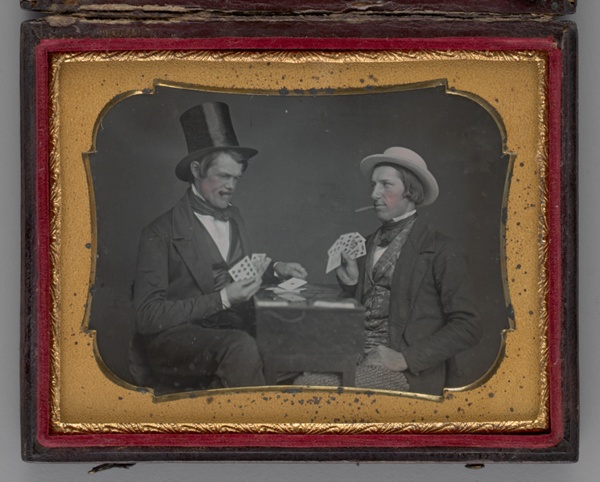
A Card Game on Polished Silver

Untitled (Two Men Playing Cards), Unknown maker, American, 19th century, 1852

The Art Institute of Chicago dates Untitled (Two Men Playing Cards) to 1852 and identifies its maker as unknown. The title supplies the activity; the process supplies another reason to linger. A daguerreotype is a photograph made directly on a silver-coated copper plate, rather than a paper print made from a negative. Its microscopic image particles sit against a polished, reflective surface. Change the viewing angle and the picture can shift between positive and negative. That makes looking a small physical negotiation: you move until the image becomes legible. This object rewards attention to the plate as much as to the card game named in its title.

Look for: Notice how the reflective surface changes the image’s legibility as your viewing angle shifts.

Image: Art Institute of Chicago, CC0 · The W. Bruce and Delaney H. Lundberg Collection, purchased with funds provided by The Leonian Charitable Trust · picked 21 Oct 2026

Letitia Felix, platinum print, c. 1898

🏛️ Cleveland Museum of Art · Platinum print

Platinum Lets the Paper Speak

Letitia Felix, Clarence H. White (American, 1871–1925), c. 1898

Cleveland Museum of Art identifies Letitia Felix as a platinum print by Clarence H. White, made around 1898. The approximate date is worth keeping: the record does not pin it to a single year. Platinum printing brings a negative into contact with sensitized paper; exposure and development leave an image of finely divided platinum within the paper’s fibers. Without a glossy gelatin coating over the image, the paper contributes directly to the surface you see. The process can carry subtle tonal transitions, but it does not automatically make every picture soft. Here, the catalogue gives us the material, not a description of White’s lighting or composition.

Look for: Look for a matte surface where the paper’s texture remains part of the image.

Image: Cleveland Museum of Art, CC0 · Gift of John Flory, Elizabeth Flory Kelly, and Phoebe Flory · picked 21 Oct 2026

Notes are written by the FernsPhoto desk from each museum's catalogue record and checked by a second editor; the desk has not seen the prints in person. Process explanations are general to the process, not claims about a particular print.